























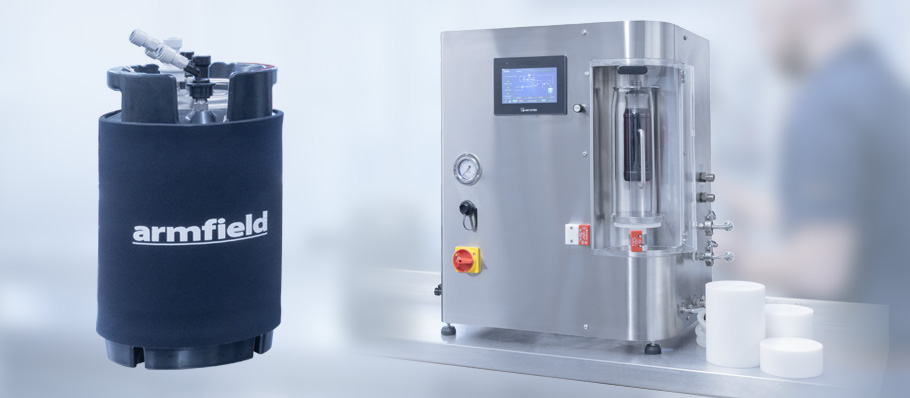
The FT102TT Table Top Carbonation & Filling Machine
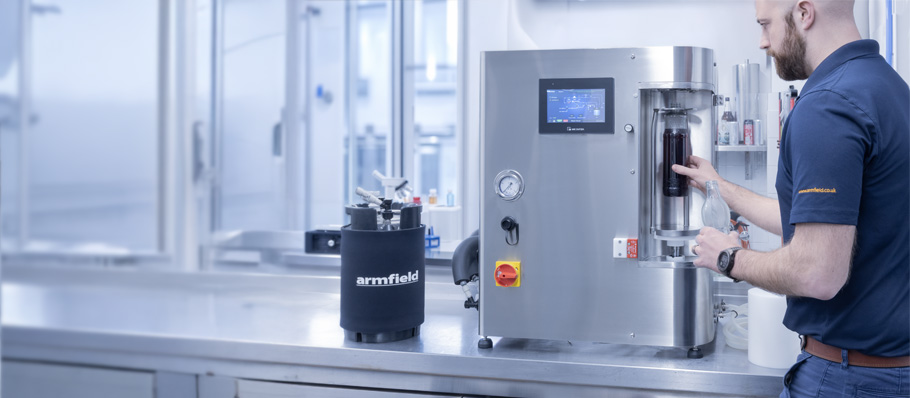
The FT102TT Table Top Carbonation & Filling Machine: Revolutionising Beverage Development with a Rapid Benchtop Carbonator and Filler
Creating a successful carbonated beverage requires far more than simply injecting carbon dioxide into a liquid. Beverage manufacturers, universities, food science departments, pilot plants and research laboratories must carefully control carbonation levels, dissolved oxygen, filling accuracy and packaging performance to develop products that are consistent, commercially viable and enjoyable to consume.
At Armfield, we have spent decades designing industrial food technology machines that help bridge the gap between laboratory experimentation and commercial production. The FT102TT Table Top Carbonation & Filling Machine has been developed specifically for organisations seeking a rapid benchtop carbonator and filler capable of delivering highly accurate carbonation, reliable filling and meaningful product development data.
Whether you are developing sparkling water, testing soft and alcoholic beverages, conducting food technology research or teaching process engineering principles, the FT102TT provides a compact yet powerful solution that delivers production-ready insights directly from the laboratory bench.
What Is the FT102TT Table Top Carbonation & Filling Machine?
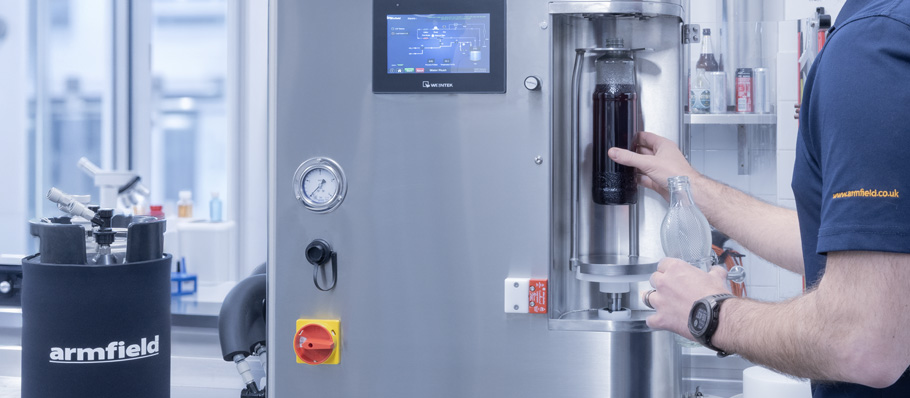
The FT102TT is a high-precision carbonator and filler designed for beverage development, pilot plant operation and laboratory testing.
Unlike large-scale production systems that require substantial floor space and significant ingredient volumes, the FT102TT offers a compact standalone unit that enables beverage developers to produce smaller batches while maintaining exceptional control over carbonation and filling parameters.
The system can process:
- Carbonated water
- Sparkling water
- Soft drinks
- Energy drinks
- Functional beverages
- Soft and alcoholic beverages
- Premixed product formulations
- Post mix configuration products
For organisations involved in research and development, the FT102TT delivers the flexibility needed to evaluate formulations before committing to large-scale manufacturing.
Why Beverage Developers Need a Rapid Benchtop Carbonator and Filler
Bringing a new beverage to market can be both costly and time consuming.
A rapid benchtop carbonator and filler allows developers to:
- Reduce ingredient waste
- Accelerate product development
- Improve product quality
- Test multiple formulations
- Evaluate packaging options
- Optimise carbonation performance
- Generate reliable R&D data
Rather than relying on assumptions, beverage manufacturers can use the FT102TT to obtain measurable, repeatable results that support confident decision-making.
This capability is particularly valuable for pilot plants, research laboratories and educational institutions where experimentation forms a critical part of the development process.
FT102TT Technical Specifications
The FT102TT has been engineered to deliver professional-level carbonation and filling performance within a laboratory-scale platform.
Key Specifications
| Specification | Details |
|---|---|
| Product Code | FT102TT |
| Gas Content | Controllable to in excess of 10 g/l |
| Carbonation Accuracy | ±0.1 g/l |
| Keg Capacity | 9.5 litres |
| Maximum Keg Pressure | 9 bar |
| Carbonation Gas | High-purity moisture-free carbon dioxide |
| Bottle Types | PET bottles and glass bottles |
| Sample Size Range | 150ml to 2000ml |
| Operation Methods | Batch or semi-continuous |
| Contact Surfaces | 316L stainless steel, silicone, PTFE and EPDM |
| Control System | PLC with full-colour touchscreen HMI |
| Process Visibility | Real-time diagrammatic display screens |
| Data Collection | Integrated process data capture |
These specifications make the FT102TT a highly capable rapid benchtop carbonator and filler suitable for beverage manufacturers, pilot plants, universities and research laboratories.
Understanding Carbonation Science
Carbonation is one of the most important factors influencing beverage quality.
The amount of dissolved carbon dioxide directly impacts:
- Mouthfeel
- Taste perception
- Product freshness
- Consumer acceptance
- Shelf stability
Accurate carbonation levels are essential when evaluating different formulations or conducting sensory trials.
The FT102TT enables users to achieve carbonation levels exceeding 10 g/l while maintaining accuracy to within ±0.1 g/l. This degree of precision allows researchers and product developers to confidently compare formulations and optimise beverage performance.
For organisations developing carbonated water, sparkling water and soft drinks, maintaining consistent CO2 levels is critical to ensuring repeatable product quality.
The Importance of Dissolved Oxygen
Dissolved oxygen is often overlooked during beverage development.
However, excessive dissolved oxygen can negatively affect:
- Flavour stability
- Shelf life
- Product freshness
- Colour retention
- Overall product quality
The FT102TT allows users to study the relationship between carbonation and dissolved oxygen, helping developers create beverages that perform consistently during storage and distribution.
This capability makes the machine particularly valuable for premium beverage development programmes.
How the FT102TT Process Works
One of the major advantages of the FT102TT is its ability to streamline beverage development while maintaining exceptional process control.
The process begins with either a premixed product or a post mix configuration using water and syrup.
The product is stored in an external 9.5-litre keg before entering the carbonation stage.
Stage 1: Product Preparation
Ingredients are blended and prepared according to the desired formulation.
Stage 2: Cooling
An external chiller or ice water supply is used to reduce product temperature.
Lower temperatures improve carbon dioxide absorption and support more accurate carbonation levels.
Stage 3: Carbonation
The FT102TT uses high-purity moisture-free carbon dioxide to carbonate the product.
The system employs:
- Manual regulator
- Pressure gauge
- Check valve
- Controlled CO2 supply
These components work together to ensure highly accurate carbonation.
Stage 4: Filling
Once carbonation has been achieved, the filler rapidly dispenses product into bottles.
The system accommodates:
- PET bottles
- Glass bottles
Bottle sizes can range from 150ml samples through to 2000ml containers.
Stage 5: Packaging
Depending on the application, users may utilise:
- Crown capping
- Screw capping
The FT102TT may also operate alongside an integral can seamer or external Seaming Machine for can-based product development.
Advanced PLC Control and Process Visibility
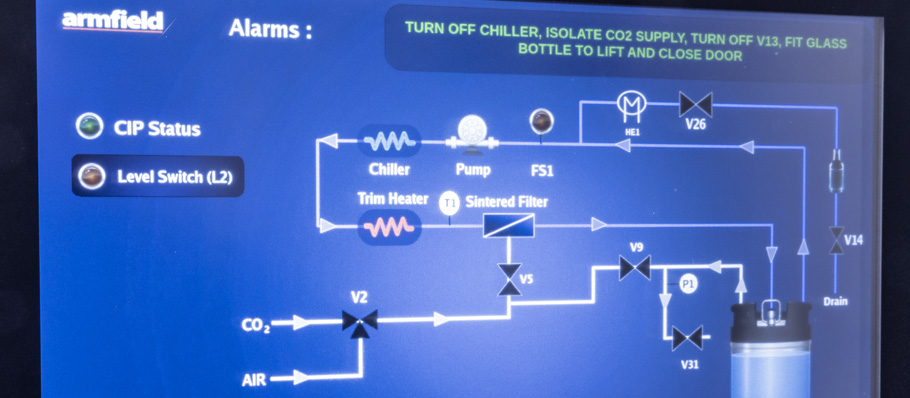
A significant advantage of the FT102TT is its advanced Programmable Logic Controller (PLC) architecture.
Many benchtop carbonation systems rely heavily on manual adjustments, which can introduce inconsistencies.
The FT102TT minimises operator variability through automated control.
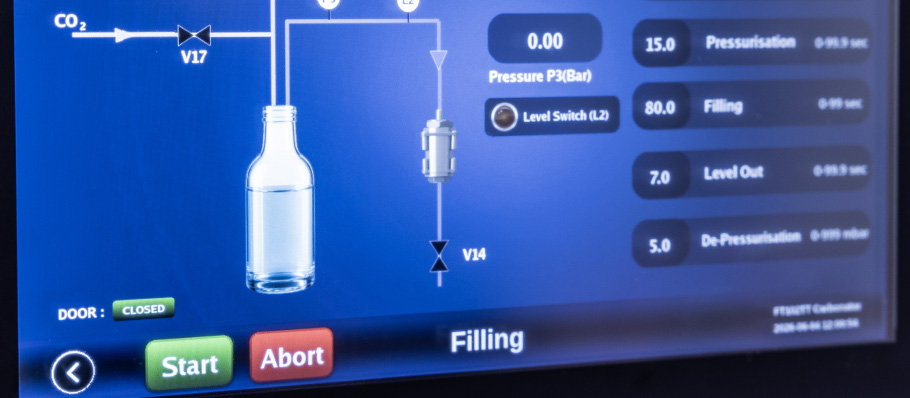
Using the full-colour touchscreen HMI, operators can:
- Create recipes
- Execute recipe functions
- Monitor carbonation levels
- Review process performance
- Capture production data
Integrated diagrammatic display screens provide real-time visibility of system operation, helping users understand exactly what is happening during each stage of production.
This level of control supports better product quality and more reliable research outcomes.
Why Ice Water Supply and Chillers Matter
One of the most common questions regarding carbonation systems concerns temperature control.
Carbon dioxide dissolves more effectively at lower temperatures.
A reliable external chiller or ice water supply helps:
- Improve carbonation efficiency
- Increase gas absorption
- Reduce carbonation variability
- Improve product quality
- Enhance process consistency
For laboratories and educational institutions, this provides an excellent opportunity to demonstrate carbonation principles and gas transfer behaviour.
Educational Applications
Armfield equipment is trusted by universities and educational institutions throughout the world.
The FT102TT provides a practical platform for teaching:
- Beverage technology
- Carbonation science
- Process engineering
- Product development
- Food technology
- Process control
- Quality assurance
Students gain hands-on experience using industrial food technology machines while developing a deeper understanding of commercial beverage production processes.
Pilot Plant Applications
Pilot plants serve as a critical bridge between laboratory development and commercial manufacturing.
Consider a research team developing a botanical sparkling water.
Using the FT102TT, they can:
- Test different ingredients
- Evaluate carbonation levels
- Measure dissolved oxygen
- Compare bottle types
- Conduct sensory analysis
- Assess product quality
Once the ideal formulation has been identified, the product can progress to larger-scale production with significantly reduced risk.
Integration with Other Beverage Systems
The FT102TT integrates effectively into broader beverage development environments.
Compatible systems may include:
- UHT Process System
- UHT System
- Water Filling Machine installations
- Juice Filling Machine operations
- Bottle Filling Machine systems
- Bottle Blow Molding Machine facilities
- Compressed air supply infrastructure
- Can seamer systems
This flexibility allows organisations to build comprehensive beverage development workflows around the machine.
Comparing the FT102TT to Commercial Production Systems
| FT102TT Table Top System | Commercial Production Line |
|---|---|
| Small batch volume | High-volume production |
| Lower ingredient consumption | High ingredient consumption |
| Research focused | Manufacturing focused |
| Ideal for pilot plants | Ideal for mass production |
| Rapid recipe development | Continuous production |
| Lower capital investment | Significant capital investment |
This comparison highlights why a rapid benchtop carbonator and filler remains an essential tool for beverage innovation.
Utility Requirements
The FT102TT has straightforward installation requirements.
Electricity
- 110-240V
- 50-60Hz
- Single socket required
Carbon Dioxide Supply
- High-purity moisture-free CO2
- Manual regulator
- 4 bar supply pressure
Compressed Air Supply
- 6 bar
- Minimal consumption
Water Supply
- Minimum 2 bar pressure
- Minimum flow rate of 5 litres per minute
These requirements make the machine easy to integrate into existing laboratories and pilot plants.
Future Trends in Carbonation Technology
As beverage development continues to evolve, carbonation technology is becoming increasingly sophisticated.
Future innovations are expected to include:
- New vacuum system technologies
- Enhanced process analytics
- Improved dissolved oxygen monitoring
- Greater automation
- More environmentally friendly processing
- Advanced product quality management
- Enhanced digital integration
Armfield remains committed to supporting these developments through innovative industrial food technology machines that help organisations stay at the forefront of beverage innovation.
Why Choose Armfield?
Armfield has established a worldwide reputation for excellence in food technology, process engineering and pilot-scale equipment.
Our expertise spans:
- Beverage processing
- Carbonation systems
- Pilot plant equipment
- Research laboratory solutions
- Educational food technology systems
- Industrial food technology machines
The FT102TT Table Top Carbonation & Filling Machine reflects this expertise by delivering exceptional carbonation accuracy, process control and operational flexibility within a compact laboratory-scale platform.
Frequently Asked Questions
How does an ice water supply affect carbonation performance?
Lower temperatures improve carbon dioxide absorption, helping achieve more accurate carbonation levels and greater process consistency.
What determines the ideal batch volume?
Batch volume depends on vessel capacity, beverage type, available ingredients and the objectives of the development programme.
How important are accurate carbonation levels?
Accurate carbonation levels ensure consistent taste, mouthfeel, product quality and consumer satisfaction.
Can the FT102TT process both carbonated water and flavoured beverages?
Yes. The system is suitable for carbonated water, sparkling water, soft drinks and a wide variety of beverage formulations.
Can the FT102TT be integrated with a UHT Process System?
Yes. The machine can operate alongside a UHT Process System or UHT System as part of a complete beverage development workflow.
What role does the regulator play?
The manual regulator controls gas pressure entering the carbonation system and helps maintain consistent carbonation performance.
How does bottle type impact performance?
Different bottle types affect carbonation retention, filling characteristics and shelf-life performance.
Can the FT102TT work with a Seaming Machine?
Yes. Depending on the configuration, the machine can operate alongside an integral can seamer or external can seamer equipment.
What industries benefit most from the FT102TT?
Universities, pilot plants, research laboratories, beverage manufacturers and food technology organisations all benefit from the system.
What future developments are expected in carbonation technology?
Future systems are expected to feature enhanced automation, improved monitoring capabilities, greater sustainability and advanced process analytics.
Contact Armfield Today
If you are looking for a rapid benchtop carbonator and filler that combines exceptional carbonation accuracy, flexible operation methods and reliable product development performance, the FT102TT Table Top Carbonation & Filling Machine provides an ideal solution.
To learn more about Armfield’s industrial food technology machines and discuss your specific application requirements, contact our team today
You may also like:
- Key Features of a Milk Product Training Apparatus
- advantages of using a dairy and plant-based products training apparatus in food technology education?
- The Science of Carbonation and Armfield’s FT102XA

Armfield can trace its history back over 130 years, throughout which, the Company’s policy of quality, innovation and service has helped it to maintain a strong market position and develop a reputation for industry leadership in the field of Engineering teaching.
Education Division
Operating since 1963, the Armfield Education Division designs and manufactures equipment for engineering education and research.
Industrial Division
The Armfield Industrial Division designs and manufactures research & development systems, primarily for the food, beverage, dairy, edible oil and pharmaceutical industries.