





























The Science Behind Saturation Pressure
The Science Behind Saturation Pressure: Understanding its Role in Everyday Life
Saturation pressure, often referred to as saturation vapour pressure, is a fundamental concept in thermodynamics and plays a vital role in understanding the behaviour of liquids, gases, and vapours. At its core, it is defined as the pressure exerted by a vapour in thermodynamic equilibrium with its liquid phase at a given temperature. This balance occurs when the rate of evaporation equals the rate of condensation, creating a stable state where no net change in phase occurs.
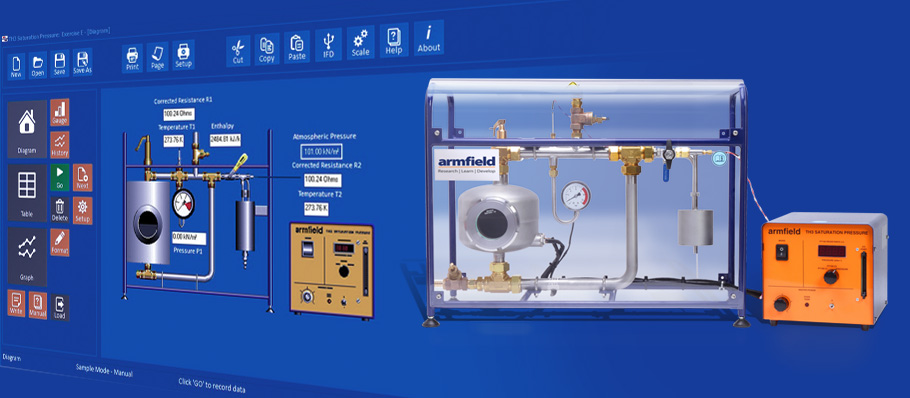
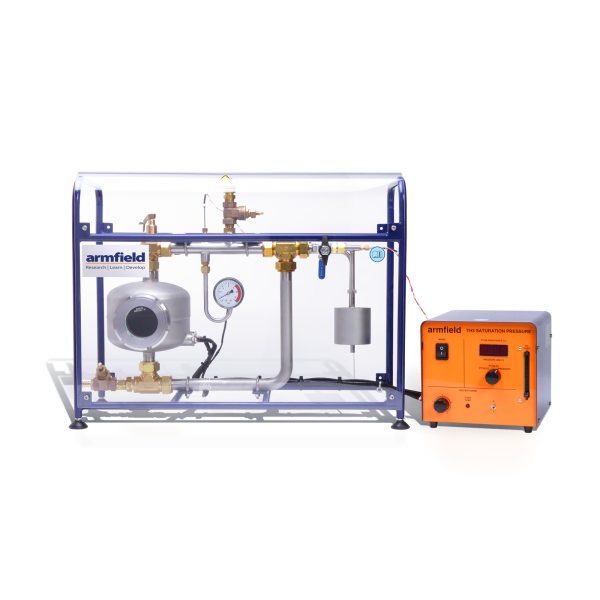
For industries such as meteorology, engineering, and chemical processing, understanding saturation pressure is essential for predicting how substances behave under different temperatures and ambient pressure conditions. At Armfield, we specialise in delivering innovative laboratory teaching equipment, including our TH -Thermo Dynamics range with Saturation Pressure Apparatus, designed to help students and professionals alike grasp these crucial concepts.
Factors Affecting Saturation Pressure
The most significant factor influencing saturation pressure is temperature. As temperature increases, the kinetic energy of the molecules also increases, leading to a rise in the vapour pressure curve. This explains why boiling water at sea level occurs at 100°C: the saturation vapour pressure equals the atmospheric pressure, and the liquid transitions into vapour.
Other factors, such as humidity and the presence of water vapour in the air, also play a role. A higher temperature means a liquid requires less additional energy to reach its normal boiling point, while at lower temperatures, it remains in a condensed or even supercooled liquid water state.
Measuring Saturation Pressure
Saturation pressure can be calculated and measured using various methods, each relying on established formulas and pressure formulations. Two commonly applied approaches are:
-
Antoine Equation: An empirical relationship providing accurate estimates of saturated vapour pressure over a range of temperatures.
-
Clausius-Clapeyron Equation: Derived from fundamental thermodynamics, this relation connects temperature and pressure changes to the enthalpy of phase transition.
For water specifically, formulations such as the Goff-Gratch formula are widely applied in atmospheric applications to provide accurate data across temperature ranges.
Saturation Pressure and Vapour Pressure
While saturation pressure and vapour pressure are often used interchangeably, there is a subtle distinction. Saturation pressure refers to the equilibrium point at a given temperature, while vapour pressure describes the pressure exerted by a vapour above its liquid in general. The two converge at equilibrium, which is why weather forecasters and climate scientists rely on them for predictions.
Understanding the vapour pressure curve is also crucial in calculating boiling point elevation or changes in a liquid’s boiling behaviour when exposed to different atmospheric pressure conditions.
Practical Applications of Saturation Pressure
Saturation pressure is not confined to academic theory—it affects countless practical processes:
-
Boiling point determination: Knowing the saturation pressure allows accurate prediction of when a liquid will boil at varying altitudes and ambient pressures.
-
Evaporation and condensation cycles: In industrial systems such as boilers or refrigeration units, managing these cycles ensures efficiency and safety.
-
Meteorology: Weather models rely on accurate representations of water vapour and saturation vapour pressure to predict humidity, cloud formation, and precipitation.
-
Closed container safety: In chemical engineering, calculating the pressure inside a closed container avoids dangerous over-pressurisation.
Calculating Saturation Pressure
For students and engineers, there are several approaches to calculating saturation pressure:
-
Reference tables, providing experimentally derived data for pure substances.
-
Online calculators, where users input a given temperature to determine the corresponding saturated vapour pressure.
-
Applying the Antoine equation, Clausius-Clapeyron relation, or more advanced formulations for high-accuracy predictions.
Controlling Saturation Pressure in Industry
In industrial applications, controlling saturation pressure ensures safe and efficient processes. Adjusting temperature and ambient pressure can be used to regulate vapour behaviour. For example, in distillation, engineers manipulate these properties to separate substances. In energy systems, keeping liquids within safe low-pressure properties avoids damaging machinery.
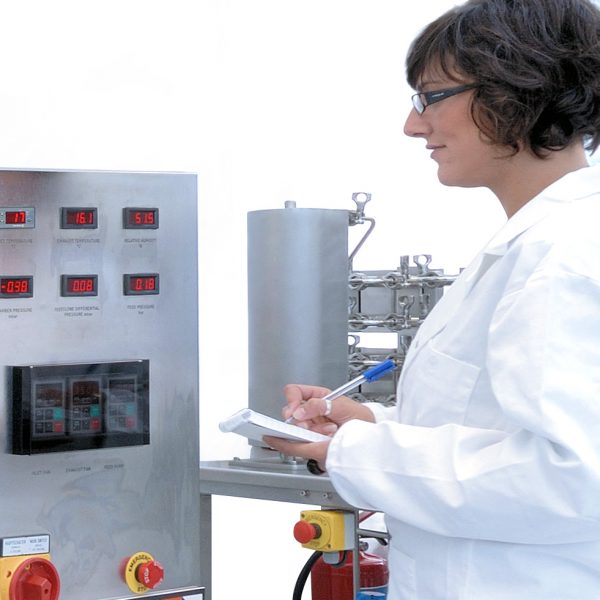
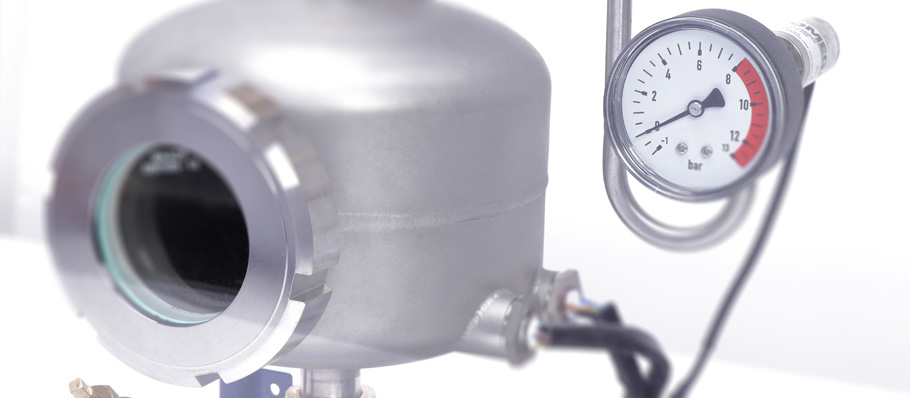
Armfield’s Saturation Pressure Apparatus offers a precise way for students and professionals to visualise and control these variables, making theoretical concepts accessible in a practical laboratory setting.
Frequently Asked Questions
1. How is the saturation vapour pressure affected by different temperatures?
Saturation vapour pressure increases with rising temperature, as molecules gain more kinetic energy and escape into the vapour phase more readily.
2. What is the relationship between the vapour pressure curve and atmospheric pressure in determining boiling point elevation?
The boiling point occurs when the saturation vapour pressure equals the atmospheric pressure. At higher altitudes (lower pressure), liquids boil at a lower temperature.
3. Can we determine the boiling point of a liquid solely based on its saturation vapour pressure?
Yes, the boiling point is defined as the temperature at which a liquid’s saturation pressure equals the surrounding pressure.
4. How does the condensed state of a liquid relate to its saturation vapour pressure?
In the condensed state, a liquid remains stable until the surrounding conditions match its equilibrium pressure, at which point phase change occurs.
Conclusion
Saturation pressure is at the heart of phase transitions, thermodynamic equilibrium, and countless scientific and industrial processes. From weather forecasting to designing safe containers and boiling water efficiently, it underpins our understanding of how matter behaves.
At Armfield, we are proud to support this field with an advanced Saturation Pressure Apparatus, enabling accurate study, experimentation, and teaching across a variety of industries. By bringing theory to life, we ensure future scientists and engineers gain the skills they need to apply these concepts in the real world.
Take the Next Step with Armfield
If you are looking to invest in reliable, innovative, and educational laboratory equipment, explore our full range of Saturation Pressure Apparatus. Contact us today to discuss how our solutions can meet your teaching or research needs.
You may also like
- CSTR Reactors: A Guide to Optimal Chemical Reactions
- Measuring the Invisible: The Fascinating World of Fluid Science Manometers
- The Impact of Steam Generators in Modern Laboratories
- The Science of Subsonic Wind Tunnels

Armfield can trace its history back over 130 years, throughout which, the Company’s policy of quality, innovation and service has helped it to maintain a strong market position and develop a reputation for industry leadership in the field of Engineering teaching.
Education Division
Operating since 1963, the Armfield Education Division designs and manufactures equipment for engineering education and research.
Industrial Division
The Armfield Industrial Division designs and manufactures research & development systems, primarily for the food, beverage, dairy, edible oil and pharmaceutical industries.