


































Inevitable Decay: Understanding the Second Law of Thermodynamics
The second law of thermodynamics is one of the most profound principles in physics, dictating the natural progression of energy and matter across the universe. Simply put, it states that the total entropy — a measure of disorder — of an isolated system will always increase over time. This law explains why heat flows from hot objects to cold ones and why certain processes are irreversible.
At Armfield, we appreciate the critical importance of mastering this principle. That’s why our Thermodynamics Training Equipment offers the perfect platform for students and researchers to understand and experiment with the complexities of thermodynamics, including the second law.
A Brief History of the 2nd Law of Thermodynamics
The development of the second law of thermodynamics owes much to pioneering figures like Rudolf Clausius and Lord Kelvin. In the mid-19th century, Clausius introduced the concept of entropy, formalising how energy tends to disperse unless constrained. Kelvin’s contributions, particularly the Kelvin-Planck statement, underscored the impossibility of achieving perfect efficiency in heat engines.
This era, influenced heavily by the Mechanical Theory of Heat, laid the foundation for modern thermodynamics. The historical journey, from the Motive Power of Fire to today’s advanced statistical interpretations, mirrors the growth of physical science itself.
Understanding the Principles: Entropy and Energy Transfer
At its heart, the second law of thermodynamics governs the flow of energy. It tells us that heat transfer (Qh) occurs spontaneously from a hot body to a cold one, never in reverse unless external work is done. The direction of heat flow, the concept of entropy change, and the limits of energy conversion are all dictated by this fundamental law.
Entropy, initially described as “energy no longer available to do work,” captures the essence of the universe’s march towards disorder. As such, whenever energy is transformed — be it burning fuel or operating an air conditioner — there is always a cost in the form of increased entropy.
You can explore our TH5 Expansion Process of a Perfect Gas unit, which offers hands-on training that vividly demonstrates these concepts.

Formulations of the Second Law: Kelvin-Planck and Clausius Statements
The Kelvin-Planck statement asserts that no device can extract heat from a single temperature reservoir and convert it entirely into work. Meanwhile, the Clausius statement focuses on heat flow, insisting that heat cannot pass spontaneously from a colder to a hotter body.
Both statements are crucial interpretations of the second law of thermodynamics and are shown to be equivalent by logical deduction. These concepts are central to our Thermodynamics Educational Series, making complex ideas accessible and demonstrable in a classroom or laboratory environment.
Real-World Applications of the 2nd Law
Everyday examples of the second law of thermodynamics abound. Consider a cup of hot coffee cooling to room temperature — a classic case of heat flow from a hot object to a cold environment. Similarly, the operation of heat engines — from piston engines to steam turbines — reflects the law’s limitations on efficiency.
Our thermodynamics training equipment is specifically designed to illustrate these processes, from reversible cycles to the inefficiencies of real-world systems. Visit Armfield’s Thermodynamics Section to see the full range of apparatus available for detailed study.
Limitations and Boundaries of the Second Law
While the second law of thermodynamics governs macroscopic systems, it does not predict the behaviour of individual particles. Quantum thermodynamics, a growing field, investigates how this fundamental law interacts with quantum systems, revealing nuances not observable at classical scales.
Furthermore, the law’s direct applicability is confined to closed systems. Open systems, such as the Earth, experience local decreases in entropy, for instance, in the formation of life, even while the total entropy of the universe continues to rise.
The Relationship to Other Laws of Thermodynamics
The second law of thermodynamics complements the first law (conservation of energy) and the third law (entropy approaches a minimum as temperature nears absolute zero). Together, they form a framework explaining the flow and transformation of energy in all physical systems.
The Zeroth law sets the stage by defining temperature and thermal equilibrium, making the second law’s statements about heat flow coherent and universally applicable.
Debates, Controversies, and Modern Interpretations
While the second law of thermodynamics is universally accepted, questions about its deeper meaning continue. Discussions around Maxwell’s demon, statistical mechanics, and the Philosophy of Statistical Mechanics explore the law’s apparent conflict with microscopic reversibility.
Debates also delve into the implications of the law for the origin of life, cosmological phenomena like cosmological inflation, and the ultimate fate of the universe — the so-called heat death scenario.
Armfield’s Solutions for Thermodynamics Education
At Armfield, we take pride in offering innovative, reliable, and precise Thermodynamics Training Equipment. Our solutions allow educators and learners to explore concepts like entropy, heat flow, efficiency, and energy transformations with clarity and hands-on experience.
If you’re looking to equip your laboratory or educational facility with world-leading thermodynamics apparatus, contact Armfield today. Our expert team is ready to help you find the right solutions to enhance your thermodynamics education.
Frequently Asked Questions
How did the Mechanical Theory of Heat contribute to the development of the second law of thermodynamics?
The Mechanical Theory of Heat established that heat was a form of energy, leading scientists like Clausius and Kelvin to frame the second law of thermodynamics. It provided the conceptual bridge between heat, work, and energy conservation.
What is a heat engine and how does it relate to the second law of thermodynamics?
A heat engine converts thermal energy into mechanical work, operating between a hot and a cold reservoir. The second law of thermodynamics places a limit on its maximum efficiency, highlighting why no real engine can achieve 100% efficiency.
How did Gibbs’ work in statistical mechanics shape our understanding of the second law?
Gibbs developed concepts like Gibbs free energy, offering a statistical perspective on energy distribution and entropy. His work made it possible to predict the behaviour of large systems from the microscopic properties of particles, deepening our understanding of the second law of thermodynamics.
In what ways do hot and cold reservoirs illustrate concepts within the second law of thermodynamics?
Hot and cold reservoirs clearly demonstrate the natural direction of heat transfer. Heat spontaneously flows from the hot reservoir to the cold one, consistent with the second law of thermodynamics, and forms the basis for the design of engines and refrigerators.
Bloom’s Taxonomy Alignment
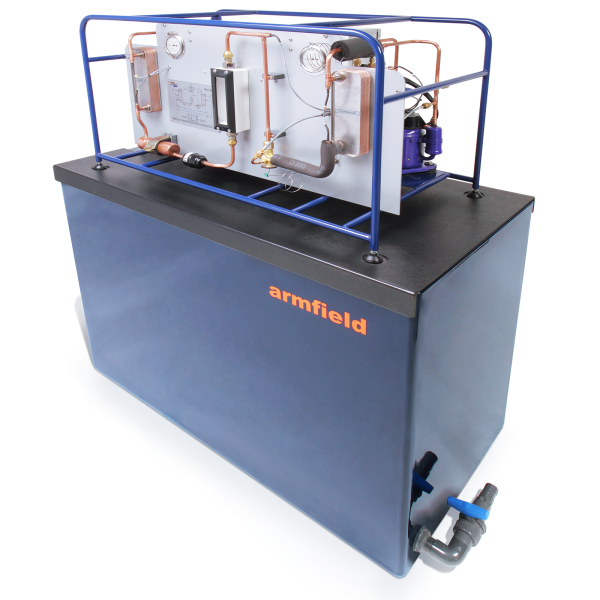
The RA1 allows students to:
- Remember thermodynamic terminology.
- Understand entropy and heat flow.
- Apply refrigeration cycle calculations.
- Analyse cycle performance using real data.
- Evaluate system efficiency and losses.
- Create improvements to operating conditions.
Ready to revolutionise your thermodynamics training?
Get in touch with Armfield’s team today!
You may also like:
- HT18X – Thermo-Electric Heat Pump
- TH1 – Temperature Measurement and Calibration
- RE16 – Advanced Thermal Energy

Armfield can trace its history back over 130 years, throughout which, the Company’s policy of quality, innovation and service has helped it to maintain a strong market position and develop a reputation for industry leadership in the field of Engineering teaching.
Education Division
Operating since 1963, the Armfield Education Division designs and manufactures equipment for engineering education and research.
Industrial Division
The Armfield Industrial Division designs and manufactures research & development systems, primarily for the food, beverage, dairy, edible oil and pharmaceutical industries.